A growing share of your customers now begin shopping the way they begin everything else. They ask an AI.
The pattern is simple. Someone puts a question to ChatGPT, Perplexity or Google's AI Mode, reads the answer it assembles, and acts on the two or three brands it names. No list of ten links. No second page. An answer, and a short cast of brands inside it.
Generative engine optimisation, or GEO, is the work of making sure your brand is one of those names.
For most ecommerce stores today, it is not. And the reason is rarely the one teams reach for first.
What GEO actually means for an ecommerce brand
When a brand notices it is missing from AI answers, the instinct is to commission a run of AI-themed articles. That rarely changes the outcome. The engines are not reading a separate AI layer. They are reading the product data, the page structure and the reputation signals the store already has, and judging them more harshly than Google ever did.
GEO, then, is mostly a stricter test of the foundations you already own, which is why a sound ecommerce AI search strategy is built on the product data and structure you already have rather than a separate campaign.
Where buyers are heading explains the urgency. Gartner predicted that traditional search engine volume would fall by roughly a quarter through 2026 as people move to AI chatbots and virtual agents, and that window is now open. Google's own AI Overviews, the feature that grew out of Google's SGE experiment, already appear on around half of searches, and when one shows up, the clicks that used to reach websites drop sharply.
How an AI engine builds a shopping answer
It helps to see what happens between the question and the answer, because every step rewards something structural.
The engine starts by splitting the question into several smaller ones rather than searching the exact phrase. It gathers candidate sources from its index, the open web and, increasingly, product feeds. From those, it decides which are clear, consistent and corroborated enough to be worth naming. Then it writes a single answer and credits a small number of sources.
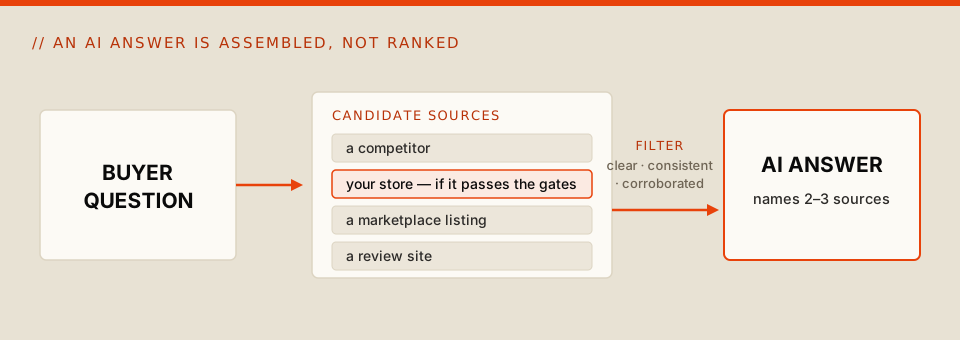
The middle step is where brands are quietly filtered out. An engine will not build an answer on a source it cannot read cleanly or cannot find backed up elsewhere.
Ranking and being named have become separate jobs
For years, ranking well on Google was a fair proxy for being found everywhere. That link has weakened. BrightEdge's tracking found that only around one in six sources cited in Google's AI Overviews also sits in the organic top ten, which means most citations come from pages that never reach the first page: the gap that makes showing up in AI Overviews a separate problem from ranking.
Ecommerce has it worse than most. In the same research, verticals like health and education saw AI citations line up closely with rankings, while ecommerce was the outlier: the overlap stayed flat and AI Overview coverage of ecommerce queries actually shrank. A strong product-page ranking tells you even less about your AI visibility than it would in another industry.
Why product catalogues are the hard case
The difficulty is structural. The pages that carry a store's commercial weight, its product and category pages, are the ones AI reads least well. Adobe, working from more than a trillion retail visits, scored retail page types on how machine-readable they are and placed product detail pages last, well behind plain-text pages like FAQs and returns policies.
Three habits cause most of the damage.
The first is hidden content. Specifications, materials and sizing tucked inside tabs that only load on click are fine for shoppers and invisible to an engine reading the initial markup. The most quotable detail on the page never registers.
The second is blocked access. A line in robots.txt or a content-delivery-network default can shut out AI crawlers entirely, so the catalogue is never seen, a technical SEO failure hiding in plain sight. It happens more often than teams realise, usually with nobody aware the setting changed.
The third is thin corroboration. Engines lean on outside agreement, from reviews, comparisons and mentions, to decide whether to trust a brand. Stores with little or inconsistent presence beyond their own site give the engine nothing to confirm, so it stays quiet.
What earns a citation
The encouraging part is that the winning moves are dull and learnable. The original GEO research from a Princeton-led team tested which changes lifted a page's visibility inside AI answers. The methods that worked were specific: adding real statistics, including quotable third-party statements, and citing credible sources, together worth up to a 40% lift. The keyword tricks of old-school SEO did worse than making no change at all.
For a catalogue, that points to a short list. Accurate, specific product data an engine can lift without guessing. Clean structured data and feeds. Brand details that stay consistent wherever you appear. And genuinely useful content that answers the exact questions buyers ask before they commit: the substance of any real AI search strategy.
A sensible order of operations
Fixing this is a sequence, and the order matters.
Begin with access. Confirm that AI crawlers can actually reach the site by checking your server logs, robots.txt and content-delivery-network settings, which is the first thing an ecommerce AI search audit checks. Improving a page an engine is blocked from is wasted effort.
Then make the product data complete and readable. Much of how to optimize for AEO is bringing specifications and answers into the page itself rather than behind clicks, and tightening the accuracy of your structured data and feeds.
Last, build the trust signals: consistent brand information across the web, credible third-party coverage, and content that answers buyer questions in concrete terms. This is the slow part, and the hardest to fake, which is exactly why it counts.
The bottom line
Generative engine optimisation is the same question search has always asked about your infrastructure, put by a stricter examiner that names only a handful of sources and offers no second page.
The brands doing well in AI did not run a GEO campaign. Their foundations were already clean enough that an engine willing to name very few sources still trusted them.
The prize is real and worth stating plainly. Both Adobe and Shopify report AI-referred shoppers converting better and spending more per visit than other channels, a gap worth tracking with AI-search-era KPIs, though the channel is still small and that edge only holds when the AI can describe your products accurately. Which lands where it began. Get the data and the structure right, and the lead compounds. Leave them, and the gap widens every month.