AI Search & GEO
Showing Up in AI Overviews: Why Ecommerce Ranking No Longer Buys You a Citation
AI Overviews don't cite the best-ranked store. They cite the one their systems can reach, render and trust. Here is the infrastructure that decides it.
Most stores treat AI Overviews as a content problem. The ones that get cited treat it as an infrastructure problem, in the layer that decides whether a system can reach, read and trust their pages.
You can sit on page one with well-written, well-structured product pages and still watch a thinner competitor get named in the AI answer while you wait below it in links nobody clicks any more. Most teams cannot explain why.
The reason is not in the prose. It is underneath it, in the layer that decides whether an AI system can reach your pages, render them, and trust them enough to cite. Get that layer wrong and better copy changes nothing. This note is about that layer.
Ranking still matters, it just stopped being enough
For years, ranking was a fair proxy for AI Overview visibility. Rank well, get cited. That link is weakening, and the data is genuinely mixed.
Ahrefs, across a study of 863,000 keywords, found the share of AI Overview citations coming from Google's top ten fell from around 76% in mid-2025 to roughly 38% by early 2026. Semrush, on a different dataset, still puts the overlap as high as 84%. BrightEdge tracked it growing to 54% over sixteen months. The studies disagree, and anyone telling you ranking is dead is overselling it.
The honest read: ranking is necessary but no longer sufficient. A large and growing share of citations now come from pages outside the top ten, or from sources that do not rank for the query at all.
Ecommerce has it worse. BrightEdge's data showed it was the exception across every industry measured: the overlap between ranking and citation stayed flat, and AI Overview coverage on transactional queries actually fell. Google appears to handle shopping queries differently from informational ones, so the ranking you fought for on a product or category page buys you less AI visibility than the same ranking would earn a blog post. It is the same dynamic at work in generative engine optimisation: weak infrastructure gets exposed, not rescued.
How an AI Overview actually picks its sources
An AI Overview is assembled, not ranked. The system reaches a set of candidate pages, reads them, and writes an answer from the passages it trusts. Three things have to be true before your store can be one of those sources. Call them reach, render and trust.
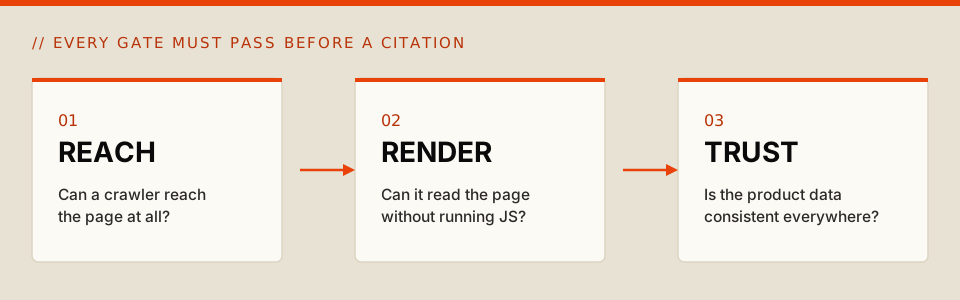
Reach: can the crawler get to you at all
AI answers are built by crawlers, and not the one you are used to. Google AI Overviews draw on Google's own index, but the wider answer layer your buyers also use, ChatGPT, Perplexity, Gemini, relies on separate retrieval bots: OAI-SearchBot, PerplexityBot, ClaudeBot and others.
A common robots.txt pattern names Googlebot and Bingbot, then applies a blanket disallow to everything else. Every AI bot that is not named falls through that wildcard and is blocked. The same thing happens at the firewall, where bot-protection rules built to stop scrapers hand a 403 to legitimate AI crawlers. The content is fine. The door is shut. This gate is binary: a blocked crawler cites nothing, however good the page is. Confirming access is the most basic discipline in any serious ecommerce AI search audit.
Render: what the crawler actually sees
Googlebot runs a headless browser and executes JavaScript, so it eventually sees your fully built page. Most AI retrieval bots do not. They read the raw HTML from the first request and move on. No waiting for scripts, no second attempt.
On a client-side rendered storefront, that raw HTML is close to empty: a shell, some navigation, a block of script tags. The price, description, specifications and reviews all load afterwards, in the browser, for humans. To a non-rendering crawler, the product effectively does not exist.
You can test it in ten seconds. Load a product page with JavaScript disabled. If the description, price and key details vanish, that is what a large part of the AI answer layer sees.
Trust: is your product data machine-readable and consistent
Reaching and reading you is not enough. The system has to trust the data enough to repeat it.
This is where structured data comes in, and where most advice oversells. SE Ranking found around 65% of pages cited by Google's AI Mode and 71% of those cited by ChatGPT carried structured data. That is a correlation, and SE Ranking said so plainly. Google's John Mueller has pointed out you do not need bot-only JSON clones of your pages; clean, well-structured HTML does most of the work. Accurate product schema, with a real GTIN, price and availability, helps a machine parse you with confidence. It does not buy a citation on its own.
For ecommerce there is a second data path generic advice ignores: the Shopping Graph. Google's AI shopping features run on Gemini and a product index of tens of billions of listings, fed largely through Merchant Center. If your feed is thin, stale, or disagrees with your site, you are handing the system conflicting signals about your own products. Conflicting signals erode trust, and the system routes around you.
The pattern under all three gates is the same. Every query that triggers an AI Overview is a query where the click can disappear before your link is ever seen. If you are not in the answer, the ranking below it is worth a fraction of what it used to be.
What this looks like in a real audit
Three patterns come up again and again.
The invisible storefront. A polished headless or single-page build that renders beautifully for shoppers and returns an empty shell to every non-rendering crawler. The team is sure the content is strong, because for human visitors it is.
The locked door. A robots.txt or firewall rule, often inherited from a security review or a platform default, that blocks AI bots while everyone assumes they are allowed. Nobody reads the server logs, so nobody notices the bots never arrive.
The contradictory record. Titles, specifications and prices that differ between the site, the Merchant Center feed and third-party listings. Each source is plausible alone. Together they tell the AI it cannot be sure which is right.
A composite makes it concrete (illustrative, not one client). A homeware brand ranks third on a category query worth roughly $40k a month in organic revenue. The query gains an AI Overview. Organic click-through on the term drops by about a third as the answer absorbs the top of the page. The brand is not in it, because its category pages render client-side and its feed disagrees with its site on three key attributes. The ranking did not move. The revenue did. Which is exactly why the KPIs that matter now measure citation, not position.
What to fix before you chase AI Overview visibility
The instinct is to add FAQ blocks and more schema. Start lower than that. If the first three gates are failing, better content changes nothing. In priority order:
- Confirm the crawlers can reach you. Check robots.txt for blanket disallows that catch unnamed bots, and check server logs for OAI-SearchBot, PerplexityBot and the rest. If they are not showing up, find out whether you blocked them or your firewall did. Do not assume access. Verify it.
- Confirm your product data exists in the raw HTML. View product and category pages with JavaScript off, or read the server-rendered source. If the commercial detail is not there before scripts run, server-side rendering or pre-rendering matters more than any markup you add on top.
- Get your product record consistent. The data on your pages, in your Merchant Center feed and on the third-party sites that describe you should agree. Where it does not, the inconsistency is actively costing you trust.
This is not a checklist you run once. The gate that is failing differs from one store to the next, which is why it is a diagnosis before it is a fix, and the diagnosis is where any durable ecommerce AI search strategy begins. Guess which gate is broken and you usually fix the wrong one.
The bottom line
AI search does not create a new visibility problem for ecommerce. It exposes an old one faster.
The stores being cited are not the ones with the cleverest copy. They are the ones whose infrastructure lets a system reach the page, read the product, and trust the data. Everything else is built on top of that, and without it the content work compounds into nothing.
The stakes are climbing, not holding steady. AI Mode now runs on Gemini 3.5 Flash and has passed a billion monthly users, ads are moving into AI Overviews, and Google's shopping experience is increasingly an answer rather than a list of links. Every month a store stays unreadable to these systems, the gap between it and its cited competitors widens. Fix the foundation now and the work compounds. Keep editing copy on top of a broken base and you will keep wondering why the AI names someone else.
FAQs
Why does my ecommerce site rank but not appear in AI Overviews?
Usually one of three gates is failing: a crawler cannot reach the page, a non-rendering bot sees an empty client-side shell, or your product data disagrees with itself across site, feed and third-party listings. Content quality cannot fix any of the three.
Do I need structured data to be cited in AI Overviews?
It helps but does not buy a citation. SE Ranking found most AI-cited pages carry structured data, and Google's John Mueller has said clean, well-structured HTML does most of the work. Accurate product schema removes ambiguity; it is not a switch.
Which crawlers do AI Overviews and AI answer engines use?
Google AI Overviews draw on Google's index via Googlebot. The wider answer layer uses separate bots such as OAI-SearchBot, PerplexityBot and ClaudeBot, which a blanket robots.txt disallow or firewall rule can quietly block.