The metrics that defined a good ecommerce SEO report five years ago now describe a world that is fading. Buyers increasingly find products inside ChatGPT, Perplexity, Google's AI Overviews, Gemini and Claude, often settling on a brand before any results page loads.
That shift produces dashboards that look broken. Organic sessions slide by twenty or forty percent while revenue holds steady or grows. Average position drifts down as conversion rate drifts up. Teams reading the old numbers end up worried about the wrong things.
What follows is a practical view of what to measure now, what to retire, and which tools earn their place. The whole field is barely two years old, so expect rough edges, and we will be honest about them.
Why the old scorecard stopped working
Traditional SEO reporting rested on three figures: organic traffic, keyword position and click-through rate. Each is failing for its own reason.
Organic traffic has become a vanity number. When a shopper asks an assistant for a wireless grinder under a certain budget and your brand gets named, there may be no click at all. They go straight to the brand that stuck.
Keyword position has lost most of its meaning. With an AI Overview on the page, top rankings shed a large share of their clicks. Holding the first spot used to guarantee traffic. Now it buys a chance at being cited.
Click-through rate is sliding everywhere, which makes any comparison against a 2023 baseline close to useless. Impressions rise while clicks fall, because the engine answers more of the question itself. The label that gets used for this is the great decoupling.
None of it means your work failed. The ground moved underneath it.
A three-layer framework
Rather than chase a long list of metrics that never speak to each other, sort them into three layers, each answering a different question.
Visibility asks whether you appear in AI answers at all. Authority asks whether the systems treat you as a source worth citing. Outcome asks whether any of it reaches the bottom line.
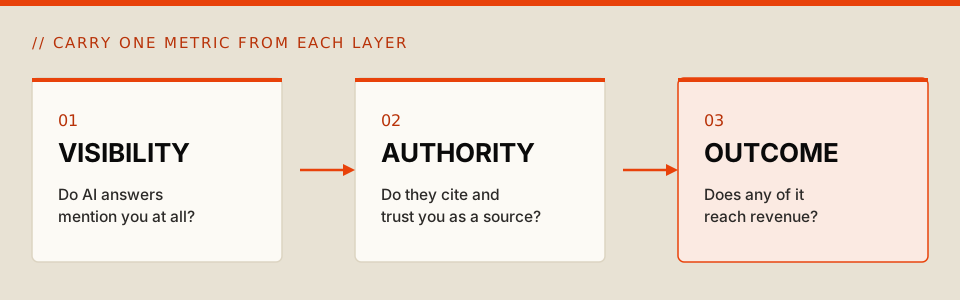
A useful dashboard carries at least one measure from each. A misleading one stacks ten visibility metrics and nothing from outcome.
Layer one: visibility
If the engines never mention you, nothing downstream matters, so visibility is the entry point, and earning those mentions in the first place is a discipline of its own.
Track how often your brand surfaces across the main engines rather than where it ranks. The same prompt rarely returns the same ordered list twice, so position is mostly noise and frequency is the signal. Compare that mention rate against a named set of three to five competitors on the buying-intent prompts that matter in your category. Measure prompt coverage too: of the twenty to fifty questions a buyer might ask, how many surface you at all, and are they branded or category-level? Treat Google Search Console carefully here, since AI Mode activity has been folded into ordinary web data with no clean way to separate it.
No tooling yet? Run the prompts by hand. Sixty to a hundred runs each gives a defensible baseline.
Layer two: authority
A mention and a citation are not the same thing. A mention names you. A citation links to you as the source. Teams routinely conflate the two.
Count how often answers actually point back to your domain: the measurement at the heart of an ecommerce AI search audit. Weigh the quality of the pages doing the citing, since a reference from a respected title carries more than one from a thin affiliate, and those pages shape what the models say about you next. Watch sentiment, because a brand mentioned mostly in negative contexts gains little from a rising mention count. And keep an eye on structured-data coverage, since product, FAQ and review markup are leading indicators of what an engine will pull.
Authority feeds visibility. Brands that appear consistently almost always have a strong citation profile behind them.
Layer three: outcome
Visibility and authority are means to an end, and the end is revenue.
This is where analytics quietly hides the answer. Sessions referred by the major assistants will not appear as their own channel unless you build a custom grouping to catch them, so set that up and watch the monthly trend. Segment conversion rate by source, because AI-referred visits often convert better than ordinary organic, though the gap varies enormously by sector, so trust your own numbers over any borrowed benchmark. Track branded search as a lagging sign that mentions are turning into demand. Read direct traffic with suspicion, since stripped referrers push a chunk of AI-influenced visits into that bucket. And report revenue per AI session, which is the figure leadership will ask about first.
What to drop, and what to add
Keep the old metrics for context, but stop building quarterly goals around them. The metrics you choose here are the scoreboard your ecommerce AI search strategy gets judged against, so the swaps matter.
Average position gives way to share of voice on buying prompts. Total clicks give way to AI-referred traffic and genuinely qualified visits. Backlink counts give way to citation counts inside answers. Page-one rankings give way to prompt coverage on category questions. Bounce rate gives way to conversion by source.
An illustrative example
Take a mid-range bedding and bath store selling through its own Shopify site. In 2023 it reported organic sessions, average position, top-ten rankings, backlinks and revenue. By late 2025 sessions were down about a third year on year, the team was rattled, and the SEO budget was under review.
Rebuilt for AI search, the picture changed. AI-referred traffic was tiny, a sliver of total sessions, but climbing steadily month on month, and it converted at several times the rate of ordinary organic. Branded search was up even as non-branded fell. The product pages, meanwhile, carried no FAQ or review markup and no clear answer-style summaries, so the store was being mentioned but seldom cited.
Out went average position, backlinks and bounce rate. In came mention rate across the main engines, citation count, the branded-search trend, and conversion segmented by source. Six months on, AI-referred revenue was a small but real share of the total, and for the first time the dashboard matched the business.
This is a made-up illustration, not a real client.
Tools, and their limits
Every measurement tool in this space is barely a year or so old. Methodologies differ, and accuracy swings by platform and category. Pick one, learn its quirks, and treat its output as direction rather than truth.
At the affordable end, prompt-monitoring tools track mentions and citations across the major engines for a modest monthly fee, which suits smaller brands and agencies. Mid-tier options add competitive analysis and analytics integrations. The larger SEO platforms now bundle AI-visibility features backed by big prompt databases, which are strong for trend direction, though independent testing has flagged accuracy gaps against manual counts. Others layer on a visibility score and sentiment analysis, useful as long as you remember a proprietary score is hard to compare across categories.
The honest summary is this. Use one tool as a directional signal, sense-check it against manual prompts now and then, and never hang a year's strategy on a single dashboard. The tools are as new to this as everyone else. For now they are best for spotting patterns, with manual checks to keep them grounded.
Common mistakes
Tracking everything and acting on nothing; pick five metrics across the three layers and report them weekly. Leaving AI traffic uncategorised so it hides inside direct and referral. Chasing visibility without watching conversion, when the two only mean something together. Comparing today's numbers against 2023 baselines that no longer describe the same world. And switching tools every quarter, which guarantees you never build a baseline worth trusting.
In closing
What you measure decides what your team improves. The brands handling AI search well are not tracking more than everyone else. They are tracking different things, on a model that matches how people actually find products now.
Start with the three layers, choose one tool, and set up your analytics grouping this week. The genuinely hard part is letting go of the metrics that used to define success.
FAQs
Can I see AI-referred traffic in my analytics?
Yes, but not out of the box. Build a custom channel grouping that tags sessions from the major assistant domains as their own channel. Without it, most of that traffic is misfiled as direct or referral and your reporting understates it.
Which AI visibility tool should I begin with?
On a modest budget, the cheaper prompt-tracking tools cover the essentials. If you already pay for a major SEO platform, its bundled AI features are a fair start. Whatever you choose, commit to it for six months before judging it.
Is traditional SEO still worth the investment?
Yes. Non-branded organic still dwarfs AI-referred traffic for most stores, and the same signals that help there, clean structure, strong content and credible links, feed AI visibility directly. What changes is the measurement, not the discipline.
How often should I review these KPIs?
Weekly for visibility, monthly for authority and outcome. Ignore daily swings; answers vary run to run, and short-term noise will send you chasing ghosts.