After keyword research, you turn the list into pages. You group keywords by what Google actually ranks, pick the groups worth money, give each group 1 page, then build, link and track those pages.
Finding target keywords is the easy part of an SEO strategy. Most keyword lists stop at the spreadsheet. The research gets done, the file gets shared, and nothing ranks because nobody did the second half. These are the 8 steps we follow on every account to turn keyword research into a keyword strategy, in order.
1. Organize your keywords into clusters by what ranks
Group keywords by what the search results show. How similar the words look is a weak guide. Two keywords belong on 1 page when Google ranks the same pages for both. When the top 10 results are different, they need different pages.
Start with the full list of keywords from your keyword research tool, seed keywords and long-tail keywords included. Then group your keywords. The check is simple. Pull the top 10 for each keyword and compare the URLs. If 3 or more overlap, it is 1 cluster, and you add the search volume together. If they share 1 URL or none, they are separate pages, even when the wording is almost identical. This is keyword clustering, and it is the step after keyword research that most SEO plans skip.
We checked this on Google US on October 19, 2026 for 2 keywords that look like twins: "linen curtains" and "linen curtain fabric". The first instinct is 1 page. The SERP disagreed. Every top result for "linen curtains" was a collection page. "Linen curtain fabric" showed 1 collection, 2 product pages and 2 buying guides. Different page types mean a different searcher, so they went into different clusters. Grouped by wording, they would have shared 1 page that matched neither search. So "linen curtains" gets a curtains collection, and "linen curtain fabric" gets its own page: a linen fabric collection sold by the meter, with a short buying guide built in on fabric weight, weave and lining. That matches the mix Google showed for the second search, part shopping and part learning.
If the site already has content, cluster what it ranks for too. Our guide on how to look for keywords on a website covers the ways to check, from Google Search Console to a simple site search.
2. Prioritize your keywords by business value
Not every keyword idea deserves a page. Score every cluster on 4 things before you write a word:
- Search intent. Is the searcher learning, comparing or ready to buy or hire?
- Keyword difficulty. Can your site compete with the pages ranking now, given its current authority?
- Search volume. The combined volume of the whole cluster.
- Closeness to what you sell. How short is the path from this page to a sale or a lead?
Volume tells you demand. Business value tells you which keywords pay. A keyword with high search volume is tempting, and SEO rankings only matter when they bring the right people. A commercial cluster with 50 searches a month often brings more leads than an informational one with 5,000, because those 50 people are ready to act.
We size this the same way in every SEO proposal. First we take the total organic demand in the category. Then we consolidate the keywords into unique page opportunities through SERP clustering. On 1 large category, that took about 100,000 keywords down to about 15,000 pages. Then we estimate the share the site can realistically capture with its authority and resources. That last number is the plan. The first one is the size of the market.
3. Map keywords to specific pages
Every cluster gets exactly 1 owning page. Group related keywords under 1 primary keyword and assign the cluster to a specific page. Write it down in a keyword map: the primary keyword, the secondary keywords, the page type, the URL and whether the page exists yet. Two pages chasing the same cluster is keyword cannibalization, and Google often splits rankings between them. A keyword map is how you avoid keyword cannibalization before it starts.
Here is part of the keyword map for this very article and the pages around it:
| Primary keyword | US volume | Page type | Role in the cluster |
|---|---|---|---|
| on-page SEO services | 30 | Service page | Hub, the page we want to sell |
| how to look for keywords on a website | 880 | Step guide | Main spoke, links up to the hub |
| what to do after keyword research | 70 | Step guide | Spoke, links up to the main spoke |
AI search adds 1 more layer to the map. Assistants like Google AI Mode and ChatGPT search split 1 question into several smaller searches, then pull a passage from whichever page answers each one. So we map the buyer's decision as well as the keyword. Write down the decision, list the 4 to 6 sub-questions behind it, and give each sub-question 1 owning page. Blogs answer 1 sub-question in depth and link to the commercial page that answers the hiring question.
4. Audit the content you already have
Before writing anything new, check your existing pages against the keyword map. For each cluster, confirm 3 things: whether a page already exists, whether it ranks anywhere, and whether it is the page type Google wants for that search.
Update a page when it already ranks on page 2 or 3. It has history and maybe a few links, so a rewrite moves faster than a new URL. Create a new page when nothing covers the cluster, or when the existing page is the wrong type, like a blog post trying to rank for a keyword where Google only shows collection pages.
The cheapest wins sit in Google Search Console. Filter your queries to positions 11 to 20. Those are keywords Google already connects to your site, and most of them only need an improved page.
5. Create or optimize content for search intent
Content creation should start from the keyword research and the SERP. Match the format to what ranks. If the top 10 are numbered guides, write a numbered guide. If they are collection pages, build a collection. A great blog post will struggle to rank for a keyword where Google only wants product listings.
Then optimize each page for its target keywords. The primary keyword goes in the title tag, the H1 and the first paragraph. Secondary keywords go in subheadings where they read naturally. Answer the questions people ask in the SERP, because those are the sub-questions AI assistants look for too. Avoid keyword stuffing. Repeating the phrase does nothing once the page clearly covers the topic.
Keep every page unique. Two pages that say the same thing split the signals Google should send to 1, which is why duplicate content is an issue for SEO even when nobody copied anything.
Your title and meta description are the first thing both searchers and search engines read, so write them for the click. We cover how search engines use meta tags, and which ones still matter, in a separate guide.
For AI search, write each section so it can stand on its own. Retrieval systems lift single passages from a page. That means a heading that states the question, the direct answer in the first sentence or two, and the subject named in each section instead of "it" from 3 paragraphs up.
6. Build internal links so authority flows to the pages that sell
A keyword map tells you what each page targets. Internal links tell Google which pages matter most. We use a reverse silo: every page links up to its parent, sibling pages link to each other in a ring, and the hub links down only to its main spokes. Every link is a vote, so you point the votes at the pages that make money.
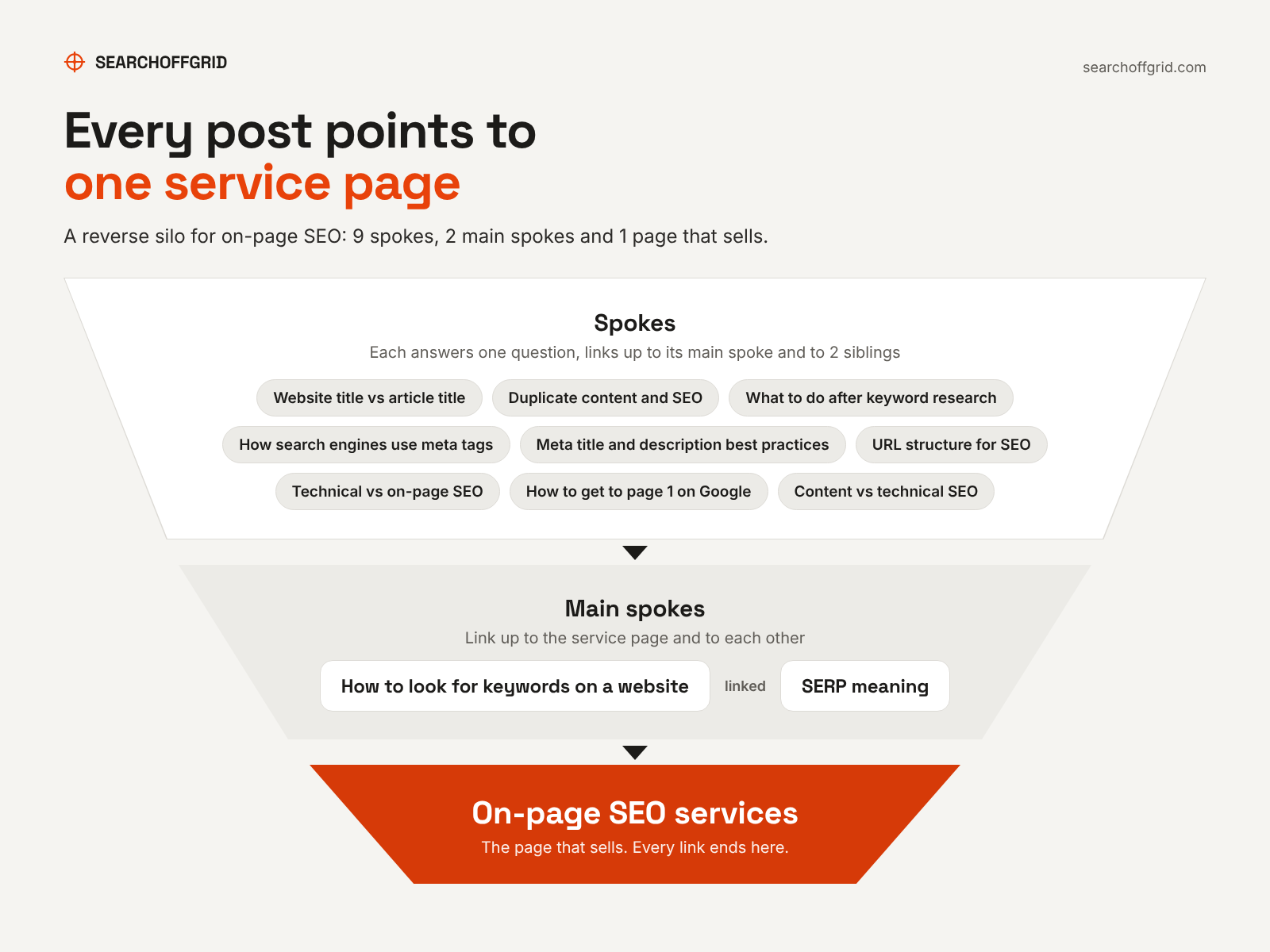
We did this on 2 Shopify stores, a cashmere store and a fabric store. Collections targeted buyers comparing options, and the products and blogs were built around them with reverse silo internal linking. The first instinct was that rankings would move once the new blogs went live. The ranking history said otherwise. Collection rankings started climbing from the linking alone, before the new pages were even published. Rewiring the pages you already have is often the fastest win on the list. Links from other sites still belong in every campaign, and internal links make the most of the authority a store already has.
7. Track keyword performance, AI visibility and leads
Once pages go live, monitor keyword performance from day 1. Track 3 things, and keep them in separate columns.
- Search performance. Keyword rankings, impressions and clicks from Google Search Console.
- Answer visibility. Whether AI assistants retrieve your page, cite it as a source, mention your business or recommend it. These are 4 different outcomes, and 1 does not guarantee the next.
- Business impact. Leads, calls and sales.
An AI answer is a snapshot. When you check one, log the date, the platform, the search mode, the location and the exact prompt. Repeat the same checks before you call anything a trend.
An Australian heating and cooling company we work with shows why the third column matters most. Ranking keywords went from 105 to 500 between April and October. That looks great in a report, and the owner still watches the phone. Clicks grew from 15 to 20 a week to over 60, and we tracked 21 organic form leads in the CRM. The leads kept the work funded. The rankings told us we were heading the right way.
8. Review and update every month
Effective keyword research is a loop, and your SEO strategy should be too. Every month, go back to Google Search Console and look for 3 things:
- New queries your pages have started showing for. Add these new keywords to the map and give them a page, or a section on an existing one.
- Two of your pages ranking for the same query. That is cannibalization starting. Merge them or make their targets clearly different.
- Pages losing positions. Refresh them first, then check whether a competitor has gained links you have not.
Then feed what you find back into step 1. The map is never finished, and that is fine. Search changes, and the map should change with it.
Turn your keyword list into pages that rank
If you have a keyword list and no plan for it, we can help. Our on-page SEO services cover the clustering, mapping, page optimization and internal linking in this guide. Send us your list and we will tell you which pages to build first.