Keyword clustering tools cost between $0 and $19.98 per 1,000 keywords, and price tells you little about how a tool groups your list. KeyClusters is the cheapest paid option with no subscription, at $3.50 to $7.60 per 1,000 keywords. Zenbrief is free up to 5,000 keywords. Keyword Insights costs $4.95 to $5.80 per 1,000 and adds briefs and writing tools on the same credits.
We read each vendor's own pricing and documentation pages on November 12, 2026. We have not run the same keyword list through all 8 tools, so this is a pricing and method comparison. Prices change, so check the linked page before you buy.
Keyword clustering tools at a glance
| Tool | Entry price | Cost per 1,000 keywords | How it clusters |
|---|---|---|---|
| Zenbrief | Free | $0 up to 5,000 keywords | Semantic similarity (NLP) |
| KeyClusters | $19 for 2,500 credits | $3.50 to $7.60 | Live Google results |
| SE Ranking Keyword Grouper | $129 a month plan, plus usage | $4.00 on top of the plan | Live search results |
| thruuu | $19 a month, or $13 billed annually | $4.70 to $12.67 | Live Google results |
| Keyword Insights | $58 a month | $4.95 to $5.80 | Live Google results |
| Keyword Cupid | $9.99 a month | $6.25 to $19.98 | Live search results |
| Semrush Keyword Strategy Builder | Paid SEO Toolkit plan | Included, capped by monthly actions | Not described in the help page |
| Ahrefs Keywords Explorer | Paid Ahrefs plan | Included | Stored Parent Topics |
The cost column assumes you spend every credit on clustering. The thruuu range runs from its Agency plan on annual billing to its Starter plan on monthly billing.
How keyword clustering tools group your list
The method decides what a cluster means, so check it before the price. The 8 tools here use 3 methods.
Live search results. The tool searches every keyword and groups the ones whose results share enough pages. KeyClusters groups keywords that share 3 or more of the top 10 pages. Keyword Insights uses a 40% overlap by default. A cluster built this way answers a practical question: can 1 page rank for all of these terms today. It costs more because every keyword needs a fresh search.
Stored results. Ahrefs groups keywords by Parent Topic, which it already holds in its database. That makes clustering instant. It also means the grouping rests on the top ranking page for each keyword instead of the whole results page.
Semantic similarity. The tool compares the meaning of the keywords themselves and never looks at the results. Zenbrief works this way. It is fast and cheap. The trade-off is that 2 phrases can read alike and still return different pages in Google.
Our approach is 1 primary intent per URL, with a cluster of close variations mapped to that page. Clusters built from live results fit that job best, because they show which terms Google already serves with the same pages. Semantic tools suit a first pass on a large, messy list.
1. KeyClusters
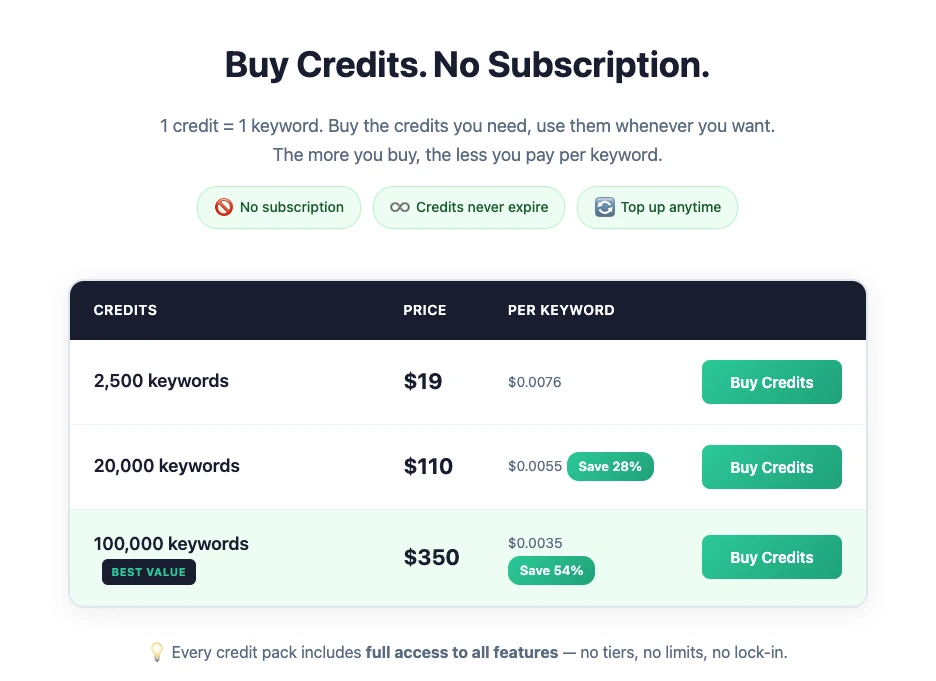
KeyClusters sells credits with no subscription, and the credits never expire.
Pricing. 2,500 keywords cost $19. 20,000 cost $110. 100,000 cost $350. That works out to $7.60, $5.50 and $3.50 per 1,000 keywords. Every pack includes every feature.
How it clusters. It runs each keyword through Google, reads the top 10 pages, and groups keywords that share 3 or more of them. You can set the country and choose desktop or mobile.
What you get. You upload an Ahrefs export, a Semrush export or your own file. A spreadsheet of grouped keywords comes back within minutes.
Watch for. The output is a file. The site lists no briefs, intent labels or planning views. The page describes a fixed rule of 3 shared pages and mentions no setting to change it.
Choose it if you cluster a few times a year and want to pay only when you do.
2. Keyword Insights
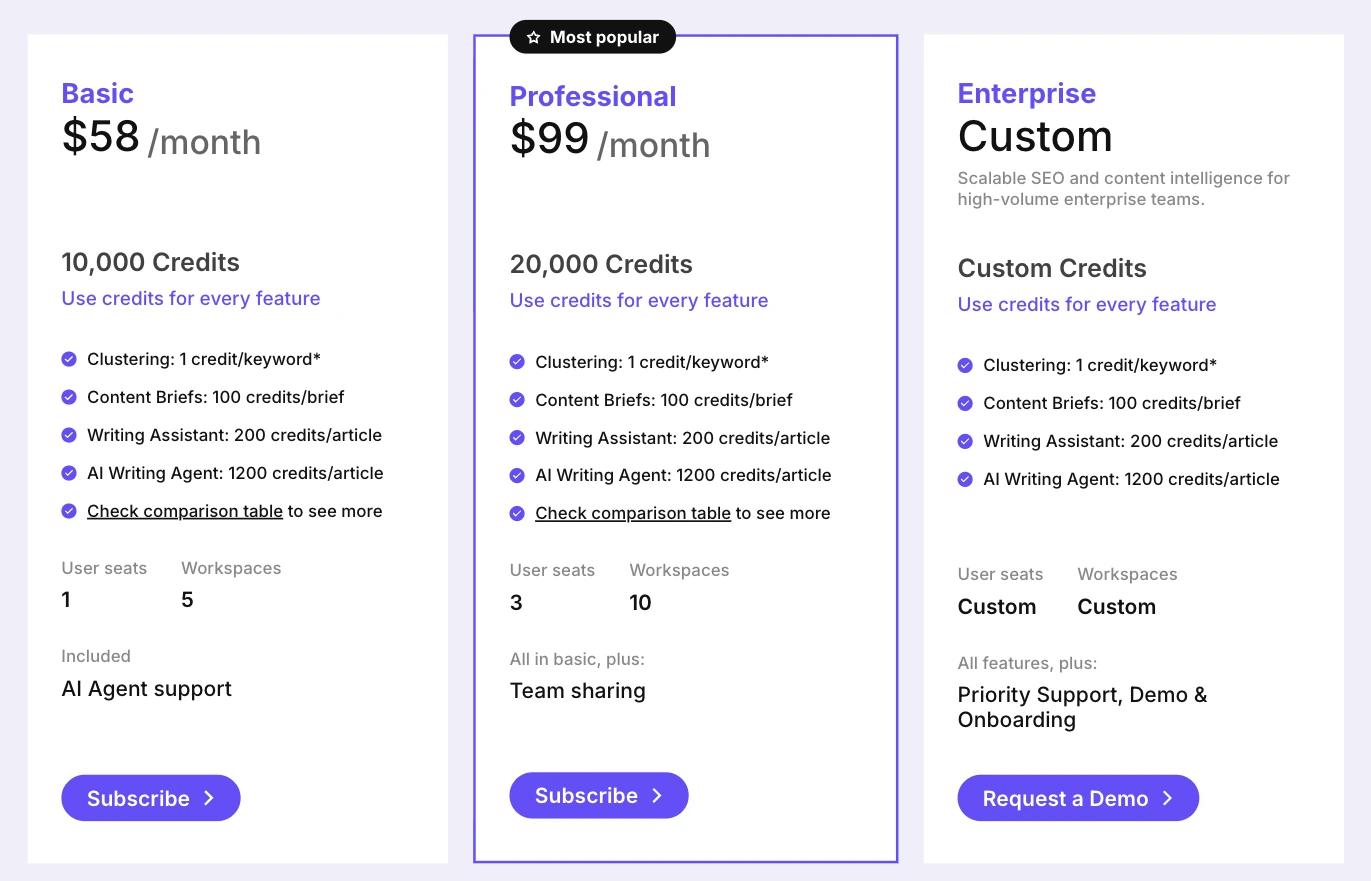
Keyword Insights puts clustering, content briefs and AI writing on a single credit balance.
Pricing. Basic costs $58 a month for 10,000 credits, with 1 seat and 5 workspaces. Professional costs $99 a month for 20,000 credits, with 3 seats and 10 workspaces. Clustering uses 1 credit per keyword, so the cost is $5.80 or $4.95 per 1,000. Annual billing saves 20%. A $1 trial runs for 7 days and caps clustering at 500 keywords.
How it clusters. Its documentation says it uses live, country-specific results and groups keywords that share 40% or more of their URLs. You can change that percentage and the algorithm. An older feature page on the same site gives different numbers, so we followed the documentation.
What you get. Clusters with a search intent label, plus briefs at 100 credits each and AI articles at 200 or 1,200 credits each.
Watch for. Briefs and articles draw from the same credits. 10 briefs use 1,000 credits, which is 1,000 keywords you can no longer cluster that month.
Choose it if you want to go from a keyword list to briefs inside the same tool.
3. Keyword Cupid
Keyword Cupid has the lowest monthly entry price and the widest range of plans.
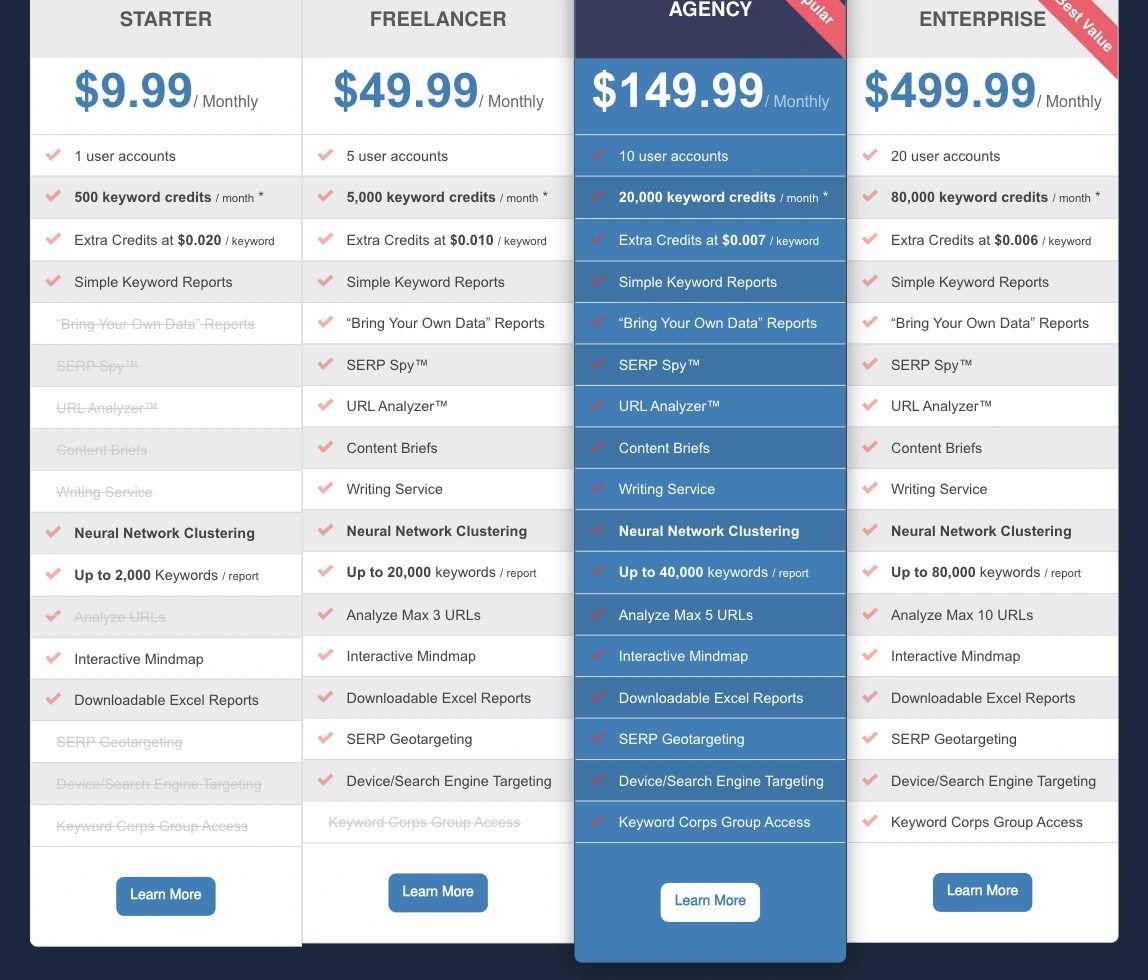
Pricing. Starter costs $9.99 a month for 500 keyword credits. Freelancer costs $49.99 for 5,000. Agency costs $149.99 for 20,000. Enterprise costs $499.99 for 80,000. Extra credits cost $0.020, $0.010, $0.007 and $0.006 each on those plans.
How it clusters. The site describes it as SERP-based clustering that groups keywords by search intent. Freelancer and higher plans let you target a location, a device and a search engine.
What you get. Every plan includes an interactive mind map and Excel reports. Content briefs, your own data uploads and SERP geotargeting start on Freelancer. Report size limits rise from 2,000 keywords on Starter to 80,000 on Enterprise. User seats rise from 1 to 20.
Watch for. Starter works out to $19.98 per 1,000 keywords, the highest rate in this list. The pricing table strikes through 9 features on Starter, including content briefs and geotargeting. Monthly credits reset at the end of each billing cycle. Extra credits you buy do not expire, and you need a subscription to buy them.
Choose it if you want a mind map of your clusters and can use 5,000 or more keywords a month.
4. thruuu
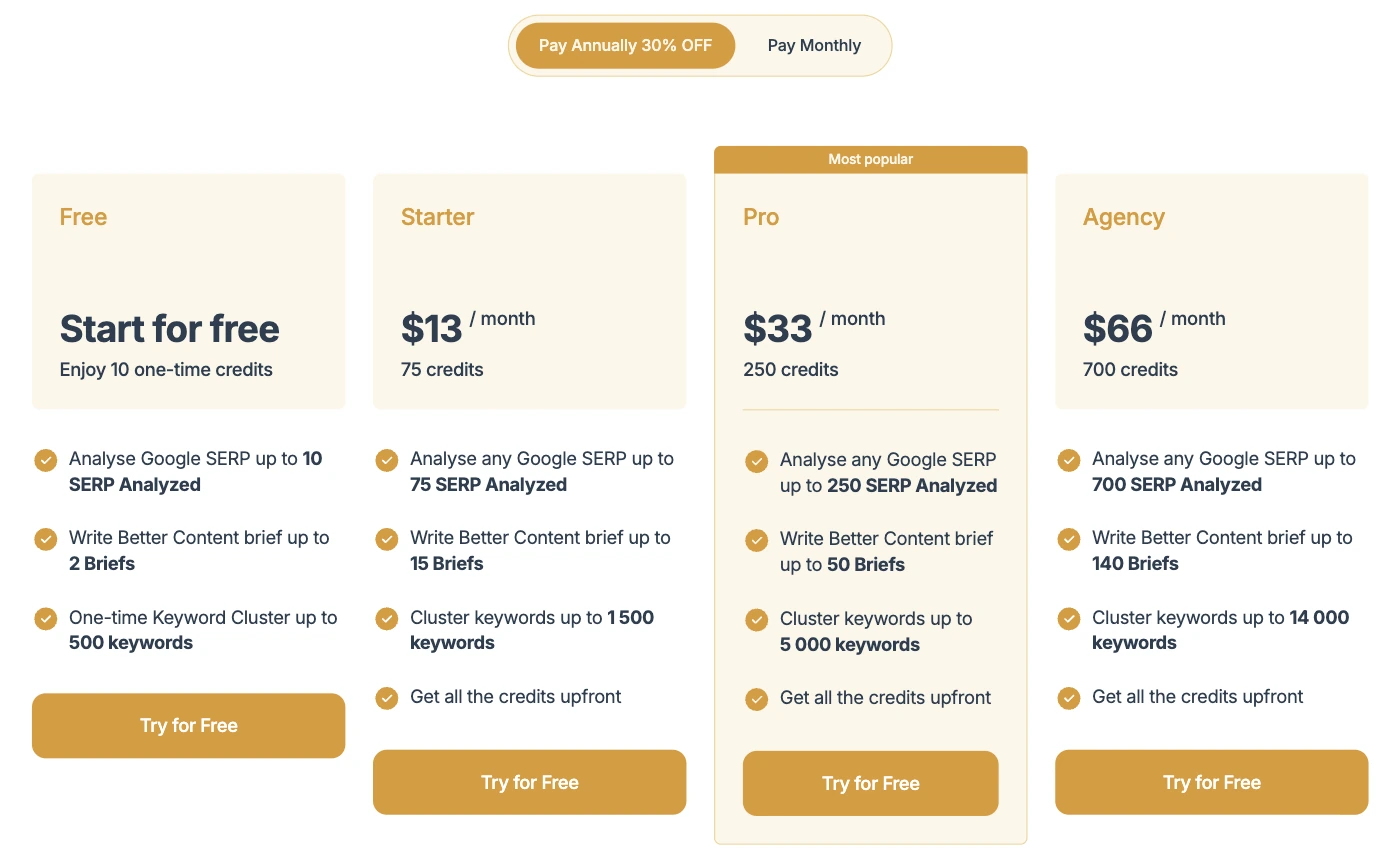
thruuu is a SERP analysis and content brief tool that also clusters keywords.
Pricing. On monthly billing, Starter costs $19 for 75 credits, Pro costs $49 for 250 and Agency costs $99 for 700. Annual billing brings those to $13, $33 and $66 a month. Clustering 1,000 keywords costs 50 credits. That is $12.67, $9.80 and $7.07 per 1,000 keywords on monthly billing. thruuu's own table lists $9.30, $6.60 and $4.70 on annual billing. The free plan includes a single 500-keyword cluster.
How it clusters. thruuu says its paid clustering uses real Google results. It also offers a separate free tool that groups by semantic similarity.
What you get. Batches of up to 5,000, 10,000 or 15,000 keywords by plan. Pro and Agency add hub and category management. Credits roll over while you stay subscribed.
Watch for. Starter's 75 credits cover 1,500 keywords, well under its 5,000-keyword batch limit. The same credits pay for SERP analysis at 1 credit and briefs at 5 credits.
Choose it if you already want SERP analysis and briefs and cluster a few thousand keywords a month.
5. Zenbrief
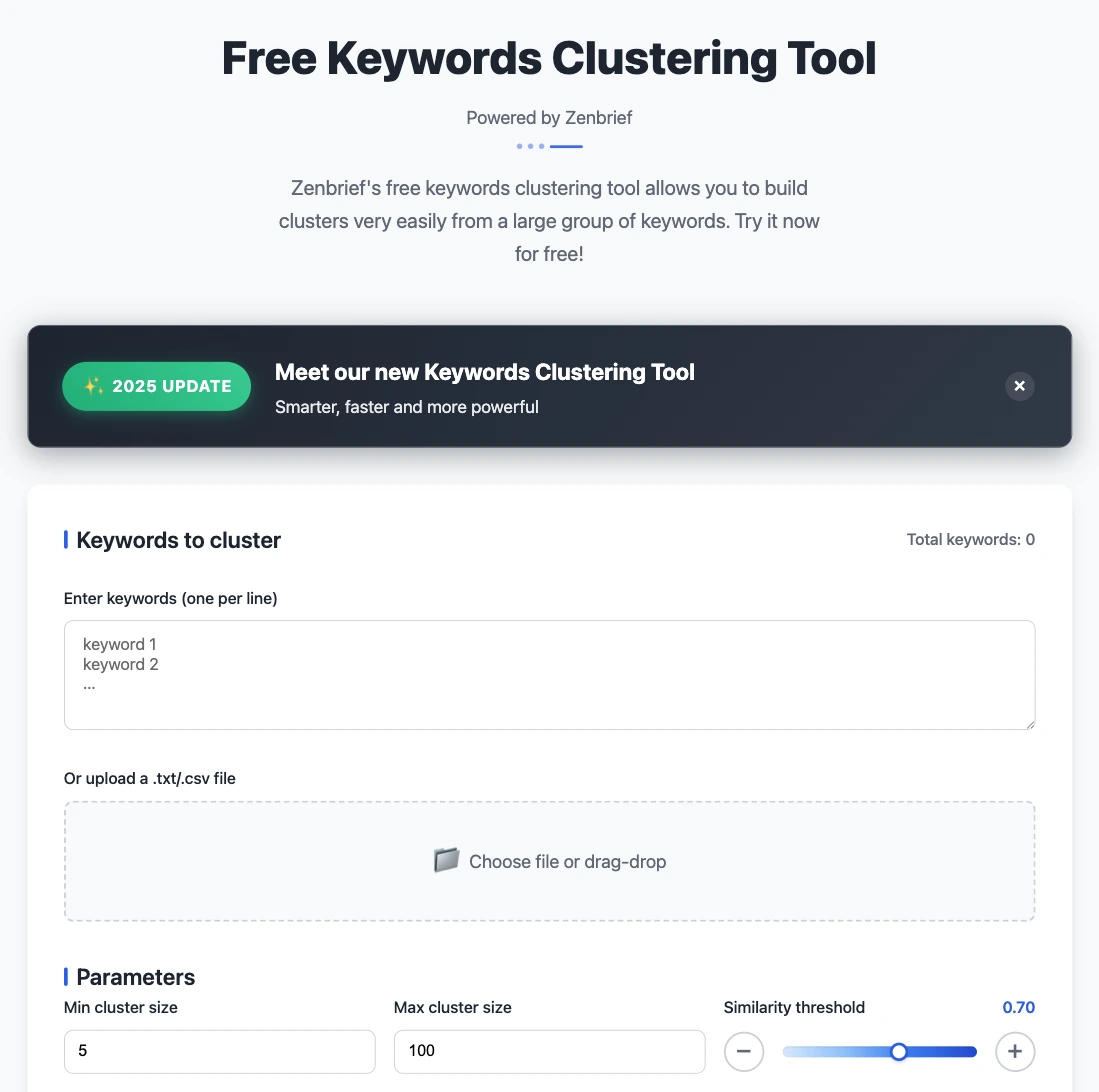
Zenbrief's clustering tool is free for lists of up to 5,000 keywords.
Pricing. Free up to 5,000 keywords, English only. Zenbrief says larger lists and advanced exports need a paid plan. We did not check those prices.
How it clusters. Zenbrief says it uses transformer embeddings and graph algorithms to group keywords by meaning. It does not search the keywords. Google's AI Overview for this topic describes Zenbrief as SERP-based or lemma-based, which does not match the tool's own page.
What you get. Settings for minimum cluster size, maximum cluster size and a similarity threshold. You can add search volume and difficulty to filter and sort the clusters.
Watch for. The tool never checks the results pages, so confirm a cluster in Google before you merge its keywords into 1 page. An older Zenbrief post still says 30,000 keywords. The tool page now says 5,000.
Choose it if you need a free first pass on an English list.
6. SE Ranking Keyword Grouper
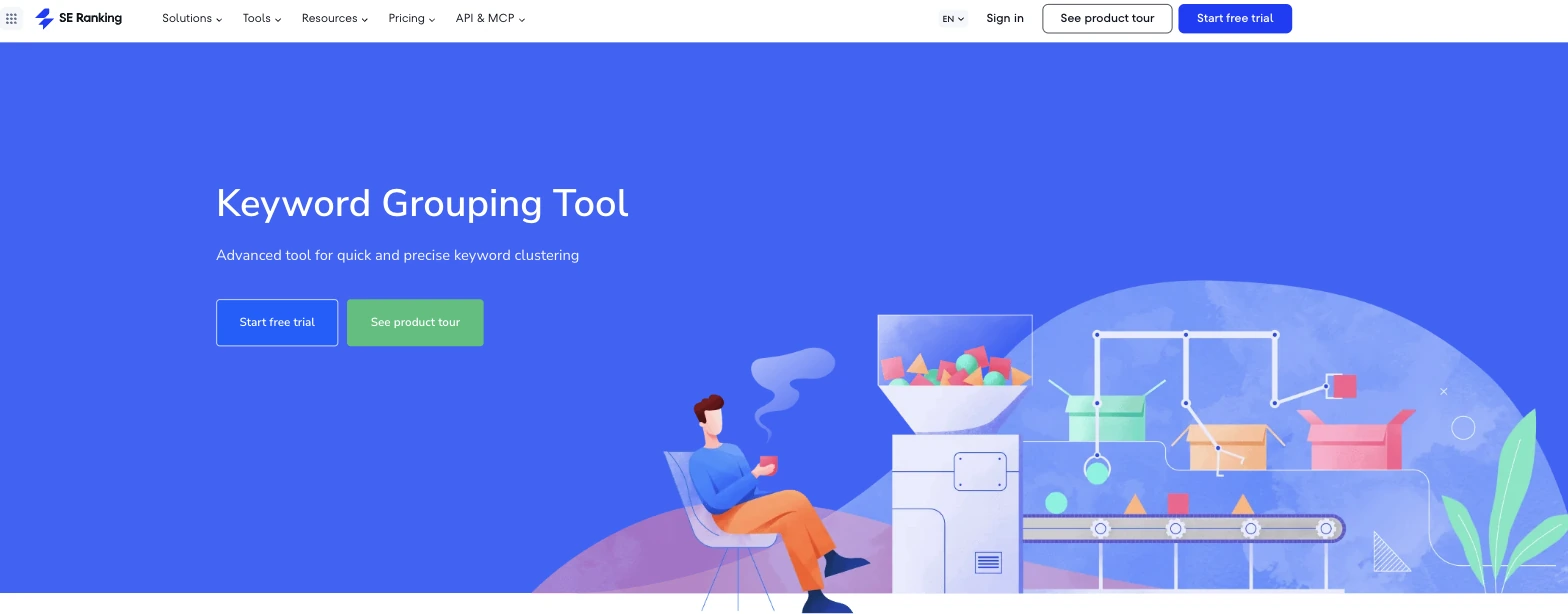
SE Ranking's Keyword Grouper is a pay-per-use tool inside a full SEO suite.
Pricing. SE Ranking's help center says grouping costs $0.004 per keyword, which is $4.00 per 1,000. Checking search volume adds $0.005 per keyword. The Grouper needs a paid plan. Core costs $129 a month, or $103.20 a month billed annually.
How it clusters. It scans the top 10 results in the region you choose and groups keywords that match the same URLs. You set the minimum number of matching URLs and the clustering method. You can narrow the location to a city or zip code.
What you get. Grouped keywords, optional search volume, and the terms Google highlights in results for each keyword.
Watch for. The $4.00 rate sits on top of the subscription. It only makes sense if you already use SE Ranking for rank tracking or audits.
Choose it if you already pay for SE Ranking.
7. Semrush Keyword Strategy Builder
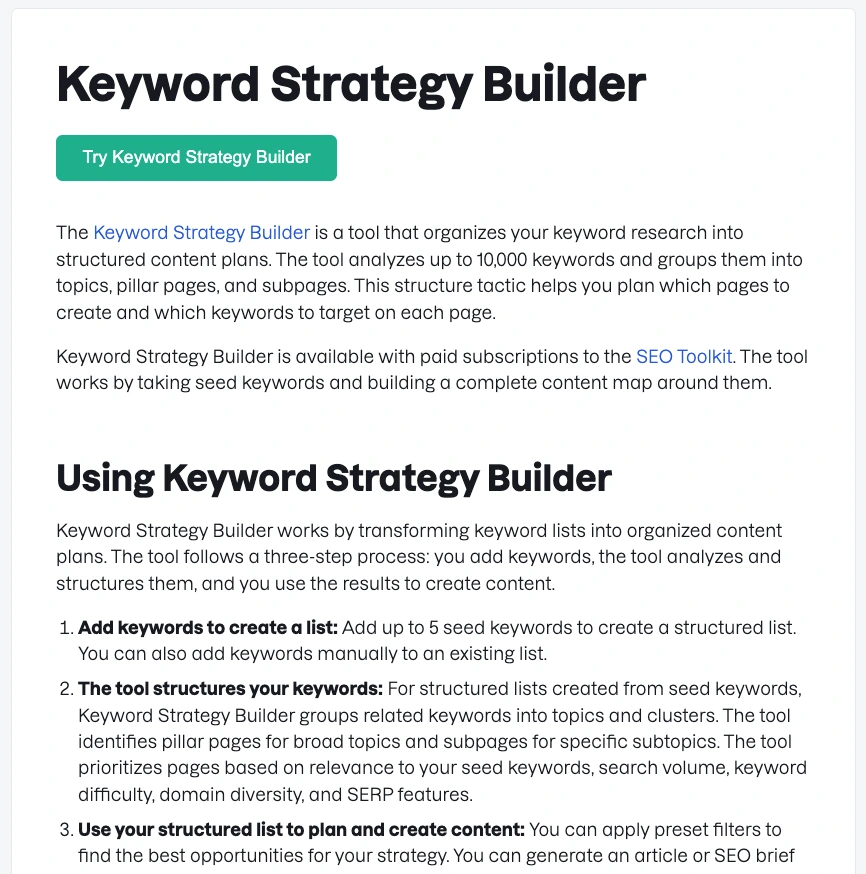
Keyword Strategy Builder is Semrush's clustering tool, included with a paid SEO Toolkit plan.
Pricing. There is no per-keyword charge. Semrush limits structuring actions instead: 10 a month on Pro, 30 on Guru and 50 on Business. We did not check the plan prices.
How it clusters. The help page says it groups keywords into topics, pillar pages and subpages. It does not describe the algorithm. A 2023 Semrush announcement said keywords with similar top 10 results were combined into a cluster.
What you get. It analyzes up to 10,000 keywords at a time, starting from up to 5 seed keywords or your own list. Accounts can store 200,000 keywords across lists.
Watch for. Deleting a list does not give that storage back. A Semrush blog post still quotes a 2,000-keyword list limit, which conflicts with the help page.
Choose it if you already do your keyword research in Semrush.
8. Ahrefs Keywords Explorer
Ahrefs Keywords Explorer clusters a list the moment you paste it.
Pricing. Clustering is part of Keywords Explorer on a paid Ahrefs plan. We did not check the plan prices.
How it clusters. It groups keywords by Parent Topic. Ahrefs finds the top ranking page for a keyword and takes the query that sends that page the most traffic. A second view groups keywords by shared terms.
What you get. Clusters for up to 10,000 pasted keywords, sorted by cluster volume, with no waiting.
Watch for. Ahrefs says on its own blog that this is arguably less accurate than some dedicated tools, because it judges similarity by the top result alone.
Choose it if you already use Ahrefs and speed matters more than precision.
How to choose a keyword clustering tool
Start with the tools you already pay for. Semrush and Ahrefs include clustering, and SE Ranking adds it for $4.00 per 1,000 keywords.
If you have no suite, match the tool to how often you cluster:
- A few times a year: KeyClusters. You buy credits once and they never expire.
- Every month, with briefs: Keyword Insights or thruuu. Both spread credits across clustering and briefs.
- Every month, at volume: Keyword Cupid's Agency plan or a KeyClusters 100,000 pack.
- A free first pass: Zenbrief, then confirm the clusters that matter in Google.
Clustering is the first step. Each cluster still needs a page type that matches its intent and internal links to the page that sells. If you want help turning a keyword list into a page plan, talk to us.